Saturday, 19 November 2011

The Best Thing since Sliced Bread

This blog is going to be the best thing since sliced bread.


Okay, well even if you don't agree with my narcissistic proclamations, at least this blog is about sliced bread.  You may not marvel at the existence of sliced bread as you pop those squares of goodness into the toaster each morning, but there was, believe or not, a time when people bought their bread....unsliced! (It was during this time people also had to walk uphill both ways to school in snowstorms).

So now you are probably wondering how those labour inducing unsliced loaves transformed into the wonderful pre-sliced bundles we have come to expect from the good people at Wonderbread and Dempsters. Or you may be hungry.

I can't solve any hunger issues but I can give you a variety of online resources to satisfy your pangs of curiosity.


1. Wikipedia - Sliced Bread
If you don't know the first thing about sliced bread, Wikipedia is a great place to start your research.  That's right - go ahead and use the oft-scorned Wikipedia. The site provides an article concisely summarizing the origins and history of sliced bread, including a note on the 1943 American ban of sliced bread. The Wikipedia platform is not conducive to in-depth analysis, but it is an ideal source for gaining a general understanding of the topic and building a foundation for further research. Now don't expect this article to actually claim that sliced bread is indeed the greatest thing - the crowds of Wikipedia enthusiasts are a pretty neutral bunch and are quite diligent in preventing outlandish statements.  So ignore those teachers and professors who lament Wikipedia's lack of academic integrity - rebel and research!

2. Modern Mechanix - Slicing Bread by Machinery, November 1929
The rebellious historian in me just told you to use Wikipedia but now my proper historian is coming out to tell you to use this primary source to check out what people were saying about sliced bread when it was the newest thing in town.  Modern Mechanix was an early American magazine and many of its articles have been digitized and placed online for perusal at the blog modernmechanix.com.  Reading this article will give you a sense of the excitement over the innovative bread slicing technology and a look at how the machinery was used to slice loaves.  This source also clearly lays out exactly who is supposed to be excited about the prospect of sliced bread. 


3. MIT Inventor of the Week - Otto Rohwedder
In order to truly understand the sliced bread phenomenon, it is necessary to know the man behind the machine, Mr. Otto Rohwedder. A detailed summary of Rohwedder's life and work is showcased on the Lemuslon-MIT website as part of its Inventor of the Week feature (the Lemuslon-MIT program is dedicated to honoring individuals whose inventions have improved our lives). It is apparent from this source that Rohwedder committed a lot of time and energy to designing and developing his bread slicing technology and is rightly called "the father of sliced bread."


4. Home of Sliced Bread - Chillicothe, Missouri
This website is a one-stop shop for everything and anything related to sliced bread.  The enthusiastic residents of small town Chillicothe and its Sliced Bread Committee made this website as an homage to sliced bread while also attempting to capitalize on its status as the birthplace of the product.  In the midst of the sliced bread T-shirts, aprons, postcards and ornaments, this site really does have some great information compiled by Chillicothe's bread-loving citizens. In addition to the general history of sliced bread, the website offers a variety of news articles relating to sliced bread, all of Rohwedder's patent information (including a pdf of the original patent), as well as photographs of the earliest bread slicing machines and of Otto Rohwedder himself.  I have a hunch that the people of Chillicothe really do think sliced bread is the greatest invention and they wouldn't be ashamed to admit it.


So there you have it - everything you need to begin your quest for sliced bread knowledge. Forget Google - if you really want to "rise" up to the challenge and "cut" through the information to have a "measure" of success, just use this blog.  After all, it is the best thing since sliced bread. Even with the terrible puns.

Wednesday, 9 November 2011

Movember Moustaches - Part 2

This blog is the second installment of my Movember Moustaches series featuring historical moustaches to coincide with the Movember campaign to raise money for prostate cancer. To find more about Movember, please click here.

You may not ever meet a man more in love with his moustache than Salvador Dali. It is reported that the Spanish artist was once carrying around a silver bell, and when asked why he had the bell, he responded “I carry it and I ring it so people will see my moustaches.” Note that he said moustaches which is not at all a misnomer if you take a look at the pictures below. While Dali is primarily known as a surrealist painter, I would like to add moustache master to his list of artistic accomplishments.


As you may infer from his distinctive moustache choice (and crazy eyes!), Dali was a tad bit eccentric. At an early age, Dali's parents told him that he was a reincarnation of his dead brother - not the most stable foundation for establishing your self-understanding.

As if his meticulously manicured moustache didn't attract enough attention, Dali had his own unique fashion sense. He often walked around in a long cape with a walking stick at his side and at one party thrown in his honour, he arrived wearing a glass case on his chest containing a brassiere. On another occasion, he arrived to deliver a lecture wearing a diving suit adorned with a jeweled dagger, with a pool cue in his hand, and two Russian wolfhounds by his side. Now that would have been an exciting lecture.  Professors, please take note.

At one point, Dali decided that he needed a pet to compliment his flamboyant personality. Naturally, he chose an ocelot. Babou the ocelot became Dali's favourite companion, even accompanying him into restaurants and on trips.


Despite his oddities, Dali was a superb artist, challenging norms and inspiring future generations of artists.  The legacy of his moustache is almost as great as that of his artistic output, and yet this generation does not seem to find inspiration in his follicle mastery.   The time to do so is now, men of Movember!


Each morning when I awake, I experience again a supreme pleasure - that of being Salvador Dali.
- Salvador Dali

Sunday, 6 November 2011

Movember Moustaches - Part 1

While the concept of growing moustaches in November (or Movember) to raise awareness for prostate cancer is a recent phenomenon, moustaches themselves have a long history.  Throughout November, I will be featuring a variety of historical moustaches that would undoubtedly win any Movember contest.  To learn more about the Movember movement, click here.

The first historical Movember candidate is none other than Ambrose Burnside, a Union general in the American Civil War whom we can thank for giving us the word "sideburn." He was obviously blessed with the ability to grow voluminous amounts of hair on the side of his face and as a result, his name was used to label the very distinctive style.  While General Burnside is known more for his sideburns  than his moustache, the argument could be made that they are in fact one and the same.


Unfortunately for Burnside, his contribution to society is limited to his facial hair. It is quite possible that he focused too much of his attention on grooming his follicles and not quite enough on leading the army. His strategy at the battle of Fredericksburg in 1862 went a little something like this:

Soldier: Great job on taking over the town General! We sure showed those Confederate scoundrels whose boss.

Burnside: Thanks soldier, but I would really love to give those southerners another kick in the pants. Why don't we go chase them as they retreat up that hill?

Soldier: Great idea! I am sure they won't be able to mow us down in their advantageous position on top of the hill. It is quite unlikely that waves of Confederates will rush down the hill and decimate our army.

Burnside's brilliant strategy led to a massive defeat for his army, but maybe it was all for the best. We wouldn't want his military accomplishments outshining his contribution as a style icon.


 This blog originally appeared on March 4, 2009 on my other blog lvanderberg.blogspot.com.

Tuesday, 1 November 2011

Adventures in HTML-Land

Saturday
Today I feel like a genius.  I am currently working my way through theW3 Schools HTML Tutorial  and this being my first foray into the world of HTML, I am finding it quite thrilling to be able to tell my computer what to do.  I just made my name appear as a heading in bold, italicized text which is when I said aloud to myself "Wow! I did it!" I know that this doesn't suddenly make me the Albert Einstein of HTML, but this process of learning the very basics of computer language is slowly subverting the relationship between me and my computer.  I have always falsely perceived my computer as a brilliant, omniscient machine, but the more I learn, the more I understand it to be what it is - a tool of human intelligence. I agree with Fred Gibbs when he writes in his blog that "Even the tiniest ability to make a computer do what one wants rather than only what software allows is tremendously empowering."

Sunday
My illusions of grandeur momentarily faded away today. As I continued to read through the tutorial and practice different things, I felt increasingly helpless due to my inability to remember all the different rules. Trying to remember where to put quotation marks, colons, semi-colons and closing tags was a bit overwhelming and my "Aha!" moment of yesterday never came. But then, like a true historian, I realized it was pointless to try and retain all this information when I will always be able to look it up.  So I persevered onward and finished the tutorial, hoping to feel empowered once again. At this point, I have started to mark-up my own page and I am quite pleased with the results thus far.  I have successfully added some lines (fancy!), headers, underlined text, an unordered list, a link and....drum roll please....some pretty colours! Although my HTML experience today didn't start well, I am once again feeling comfortable and confident to continue with my HTML adventure. Onwards and upwards from here!

Monday
Today I finished marking up my very own page!  I had some difficulties toward the end with adding images to the page, but eventually made it work with a little help from someone much wiser than myself. The finished product is pretty simple and definitely won't take your breath away, but I am stepping away from it with a great sense of accomplishment. This exercise only touches the surface of what can be accomplished with HTML and I am eager to expand my knowledge further. Being able to comprehend what was previously a foreign language, even in the most basic sense, has made technology and computers feel more accessible.  I don't know if I ever will classify myself as a digital humanist, but gaining new skills in the technological realm equips and motivates me to explore the diversity of the digital world.

Thursday, 27 October 2011

Risk according to Frank Zappa

There is a magnet on my fridge that says "Without deviation from the norm, progress is not possible." Good ol' Frank Zappa. I wish I could say I bought that magnet to reflect my personal philosophy in life, but really, it just happened to be left behind when I moved into my first house. Deviating from the norm often requires risk and when risk is involved, I tend to run in the opposite direction.

When the discussion in our Digital History class turned to taking risks in grad school, I stopped to consider whether or not being in the Public History program involved any risk.  My initial thought was no. It is relatively safe to go into a program that focuses on giving you knowledge and hands on experience for multiple career paths. The collaborative nature of the program also means that our entire group will be accountable for any risk or experimentation that is a part of our final project. Students in the traditional history graduate programs do not have the same opportunity to share the burden or success of their risks, nor do their programs encourage diverse outcomes in terms of post-graduate opportunities. So while the public history program deviates from traditional historical scholarship, I would argue that it is initially a less risky path to take.

This is not to say that being a public historian does not provide the occasion for risk.  After we graduate, many of us within the public history program hope to move onto careers within the heritage sector.  The opportunities awaiting us are unknown, but within them is our chance to take a risk.  Whether we are creating programs, developing interpretive plans or curating exhibits, we will be faced with the choice between sticking with what is familiar or pushing the boundary of what has previously been achieved.   The risk we avoid in graduate school awaits us in our careers and we must be prepared to undertake the less traveled path in order to progress.  That of course is easier said than done.  Risk is not the natural course of action for many of us, nor is it always supported by institutions or colleagues.  I guess otherwise it wouldn't be called a risk.

The class discussion forced me to question my own ability to pursue risk and innovation in my work.  Right now, I have to admit that I have a tendency toward what is safe, fearing the potential of failure and the uncertainty of what lies beyond the broadened horizon.  For that reason, I have a feeling Mr. Zappa's words will hang on my fridge for a long time, serving as a reminder of the possibilities of progress when I am tempted to run toward the status quo.

Sunday, 9 October 2011

Algorithmic Culture

It is probably not a surprise to to you that I have a severe case of technological ineptitude. I am an aspiring historian after all - how much do I really need to know about the strange universe called the world wide web?  Well, it turns out, I need to know a lot. My skills in the realm of twitter, facebook and blogging won't get me very far in this digital age of academics. The first two books for my Digital History course -Blown to Bits and Web Dragons - made that fact abundantly clear.

Despite my lack of comprehension of all the techno-speak in the two books, it was quite fascinating to learn about the systems and culture guiding the development of the Internet.  As a tool I use each and everyday, it is surprising how much trust I place in a technology that I barely understand.  The most interesting concept arising from the two books is the discussion of the lack of neutrality and subjectivity within search engines.  Although the development of the Internet has allowed for the democratization of information, our access to that information is not as democratic as one might assume.  Because technology is incapable of human reasoning, search engines rely on complex algorithms to answer our questions and we in turn place our trust in them as an authority for our source of knowledge.

These are concepts I can't quite wrap my head around - but the good news is, I found someone who can discuss the topic more eloquently than myself.  Click the link below to listen to a discussion with Ted Striphas from Indiana University as he talks to CBC radio about algorithmic culture and "the social implications of leaving discovery and serendipity, the very cornerstones of culture, to complex math."


Friday, 7 October 2011

Who Says Field Trips are for Kids?

Fridays were made for field trips.  Graduate school generally requires more field work rather than field trips, but then again, public history isn't your regular graduate program.  Our public history group has been tasked with developing an i-phone app tracing the retreat of General Proctor and Tecumseh up the Thames River during the war of 1812, coinciding with the bicentennial of the war next year. As an introduction to this project, we spent the day visiting important sites along the Tecumseh Parkway - all the way from Amherstburg to Thamesville.

A few highlights:

 Fort Malden National Historical Site of Canada

St.John's Church at corner of Brock St. and Sandwich St. in Sandwich, ON

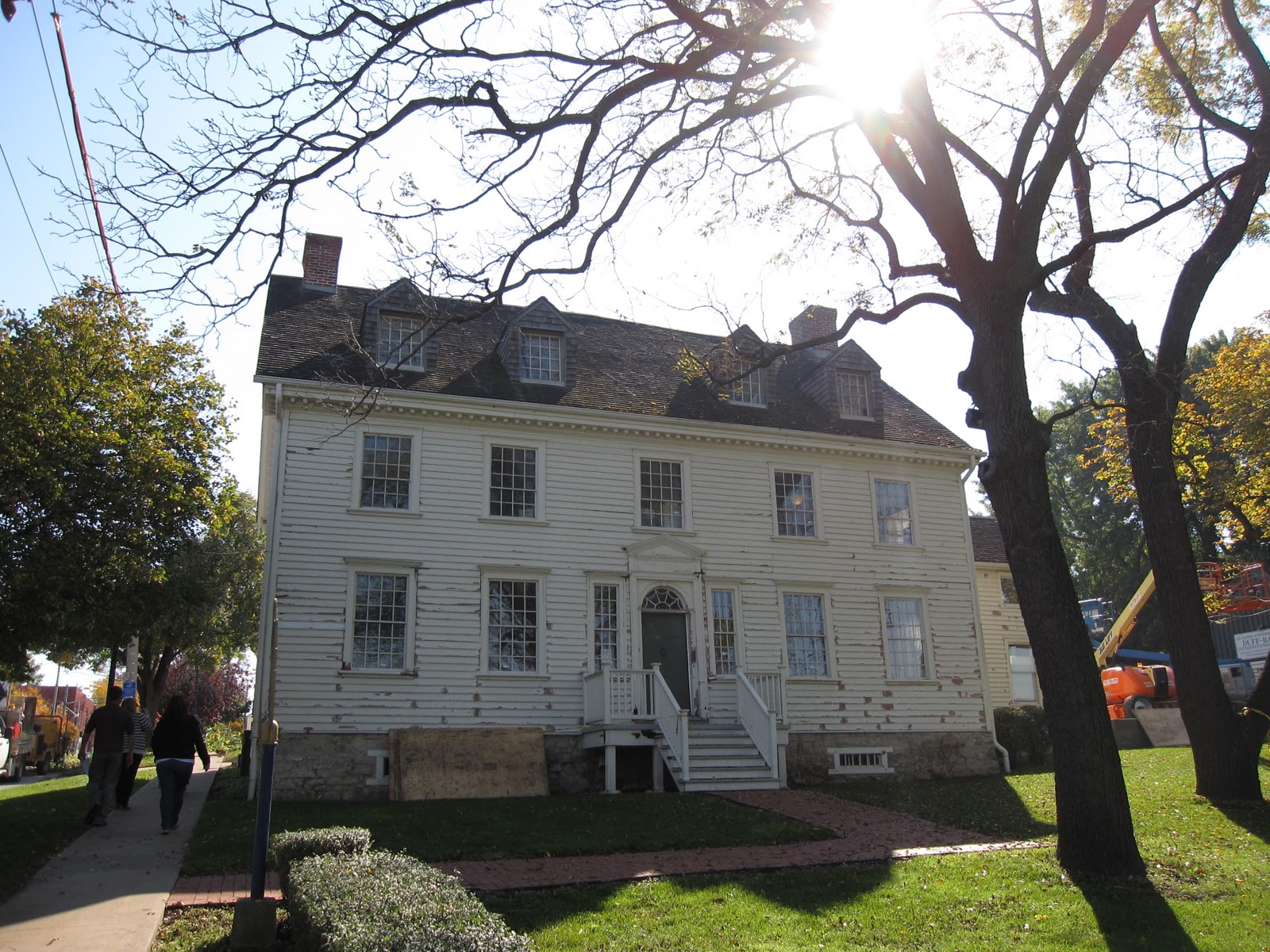
Duff-Baby House in Sandwich, ON

St.Peter's Church - Tilbury, ON


As a foreigner (from Alberta), my knowledge of the war of 1812 and this region is...well...severely lacking. My synopsis of the war before embarking on this project would have gone something like this:

The British and First Nations fought the Americans. 
Laura Secord told warned someone the Americans were going to attack.
The White House was burned.
I think the British won. Go Canada!

Embarrassing, I know.  While today was really just a whirlwind tour short on detailed explanations, I was still able to come away with a tangible sense of the scope and geography of the British retreat and feel more equipped to tackle this project.  

Physically tracing the route the soldiers took all those years ago also highlighted the important benefits of relating history to physical space.  A text can inform me of the events of the war of 1812, but taking that knowledge into a perceptible environment makes history palpable in a way that cannot be achieved through mere study. The experience of stepping into a house where Tecumseh ate dinner, standing in a field where soldiers camped and walking onto a former battlefield can never be understood without engaging with the physical space.  Historical understanding is significantly enhanced through spatial relations.  This may seem like an obvious concept, but it is one I did not reflect upon until I followed the route of the 1812 retreat for myself and connected with the history at an organic level.

It is with this in mind that I am going to approach the creation of the i-phone app.  If we can use the technology to allow its users to imagine the past through an immersion in their environment, I think we will have been successful.