There is a magnet on my fridge that says "Without deviation from the norm, progress is not possible." Good ol' Frank Zappa. I wish I could say I bought that magnet to reflect my personal philosophy in life, but really, it just happened to be left behind when I moved into my first house. Deviating from the norm often requires risk and when risk is involved, I tend to run in the opposite direction.
When the discussion in our Digital History class turned to taking risks in grad school, I stopped to consider whether or not being in the Public History program involved any risk. My initial thought was no. It is relatively safe to go into a program that focuses on giving you knowledge and hands on experience for multiple career paths. The collaborative nature of the program also means that our entire group will be accountable for any risk or experimentation that is a part of our final project. Students in the traditional history graduate programs do not have the same opportunity to share the burden or success of their risks, nor do their programs encourage diverse outcomes in terms of post-graduate opportunities. So while the public history program deviates from traditional historical scholarship, I would argue that it is initially a less risky path to take.
This is not to say that being a public historian does not provide the occasion for risk. After we graduate, many of us within the public history program hope to move onto careers within the heritage sector. The opportunities awaiting us are unknown, but within them is our chance to take a risk. Whether we are creating programs, developing interpretive plans or curating exhibits, we will be faced with the choice between sticking with what is familiar or pushing the boundary of what has previously been achieved. The risk we avoid in graduate school awaits us in our careers and we must be prepared to undertake the less traveled path in order to progress. That of course is easier said than done. Risk is not the natural course of action for many of us, nor is it always supported by institutions or colleagues. I guess otherwise it wouldn't be called a risk.
The class discussion forced me to question my own ability to pursue risk and innovation in my work. Right now, I have to admit that I have a tendency toward what is safe, fearing the potential of failure and the uncertainty of what lies beyond the broadened horizon. For that reason, I have a feeling Mr. Zappa's words will hang on my fridge for a long time, serving as a reminder of the possibilities of progress when I am tempted to run toward the status quo.
Showing posts with label Public history. Show all posts
Showing posts with label Public history. Show all posts
Thursday, 27 October 2011

Friday, 7 October 2011
Who Says Field Trips are for Kids?
Fridays were made for field trips. Graduate school generally requires more field work rather than field trips, but then again, public history isn't your regular graduate program. Our public history group has been tasked with developing an i-phone app tracing the retreat of General Proctor and Tecumseh up the Thames River during the war of 1812, coinciding with the bicentennial of the war next year. As an introduction to this project, we spent the day visiting important sites along the Tecumseh Parkway - all the way from Amherstburg to Thamesville.
A few highlights:


As a foreigner (from Alberta), my knowledge of the war of 1812 and this region is...well...severely lacking. My synopsis of the war before embarking on this project would have gone something like this:
A few highlights:

Fort Malden National Historical Site of Canada

St.John's Church at corner of Brock St. and Sandwich St. in Sandwich, ON
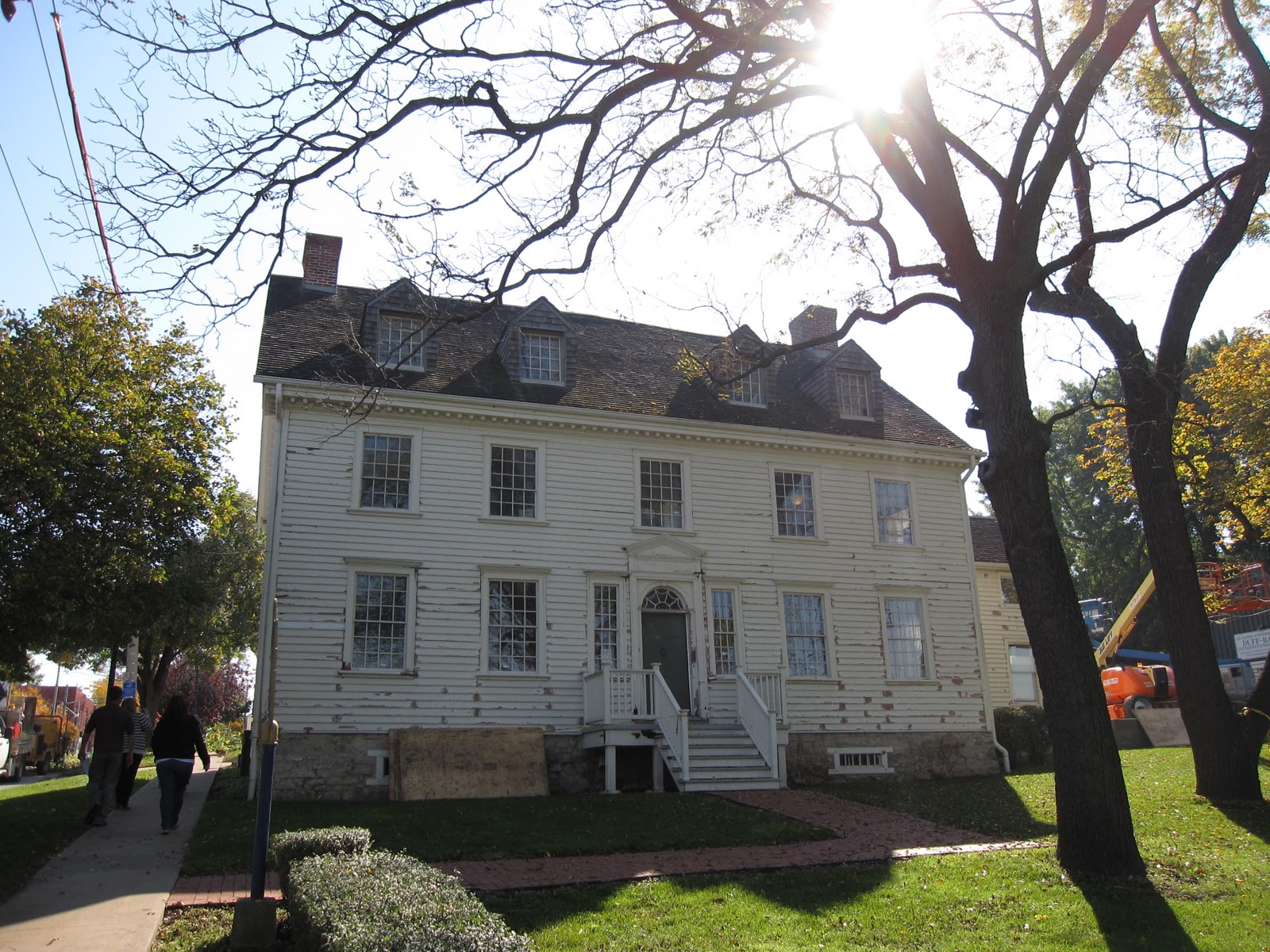
Duff-Baby House in Sandwich, ON

St.Peter's Church - Tilbury, ON
As a foreigner (from Alberta), my knowledge of the war of 1812 and this region is...well...severely lacking. My synopsis of the war before embarking on this project would have gone something like this:
The British and First Nations fought the Americans.
Laura Secord told warned someone the Americans were going to attack.
The White House was burned.
I think the British won. Go Canada!
Embarrassing, I know. While today was really just a whirlwind tour short on detailed explanations, I was still able to come away with a tangible sense of the scope and geography of the British retreat and feel more equipped to tackle this project.
Physically tracing the route the soldiers took all those years ago also highlighted the important benefits of relating history to physical space. A text can inform me of the events of the war of 1812, but taking that knowledge into a perceptible environment makes history palpable in a way that cannot be achieved through mere study. The experience of stepping into a house where Tecumseh ate dinner, standing in a field where soldiers camped and walking onto a former battlefield can never be understood without engaging with the physical space. Historical understanding is significantly enhanced through spatial relations. This may seem like an obvious concept, but it is one I did not reflect upon until I followed the route of the 1812 retreat for myself and connected with the history at an organic level.
It is with this in mind that I am going to approach the creation of the i-phone app. If we can use the technology to allow its users to imagine the past through an immersion in their environment, I think we will have been successful.
Subscribe to:
Posts (Atom)